Asthma Journey
India entered an era of economic liberalization and rapid market reform in 1991. The decades that followed brought tremendous economic growth and opportunity, but that progress also came with significant environmental costs. Across Delhi and the surrounding National Capital Region (NCR), bicycles and other low-emission forms of transportation gradually gave way to rapidly increasing numbers of cars, motorcycles, buses, trucks, and other motor vehicles. At the same time, accelerated industrialization, relentless construction, road dust, and the seasonal burning of agricultural waste contributed to steadily deteriorating air quality. Over time, Delhi-NCR became one of the most polluted urban regions in the world. For millions of people living there, polluted air became an unavoidable part of everyday life—and for those with respiratory conditions, its effects could be particularly severe.
Prem began experiencing significant asthma flare-ups around the year 2000. Her asthma appeared to be predominantly non-allergic and was often aggravated by deteriorating air quality, particularly vehicle exhaust, construction dust in the neighborhood, and other sources of airborne particulate matter. Her symptoms tended to become worse during the winter months, when cooler temperatures, stagnant weather, and smog could keep pollutants trapped close to the ground for extended periods. Her respiratory problems were further complicated by an area of scarring in the lower portion of her right lung. This area appeared to be particularly vulnerable to recurrent infections, which at times occurred only a month or six weeks apart. Respiratory infections frequently triggered or intensified her asthma, beginning a cycle of coughing, wheezing, breathlessness, medications, and gradual recovery that became all too familiar to Prem and her family.
After consulting several pulmonologists in Ghaziabad, Prem eventually came under the care of Dr. Neerav Tyagi, who remained her primary pulmonary physician for more than 25 years, from around 2000 until 2025. Over those years, her treatment evolved with the severity of her condition. Her regular asthma medications included rescue inhalers such as short-acting beta agonists (SABA), along with longer-acting LABA and LAMA bronchodilator therapies intended to keep her airways open and reduce day-to-day symptoms. Because inflammation in her lungs remained difficult to control, oral corticosteroids also became a long-term part of her treatment. When Prem was doing well, she generally took a relatively low maintenance dose of Deflazacort—approximately half of a 15 mg tablet on alternate days. During more serious asthma flare-ups, however, the dose sometimes had to be increased to as much as 30 mg daily for a limited period, often accompanied by antibiotics when an underlying respiratory infection was suspected. On some occasions, her physician prescribed methylprednisolone instead.
The treatment allowed Prem to keep her asthma under sufficient control to continue teaching, traveling, painting, managing her home, and enjoying everyday life. But maintaining that stability came at a price. Long-term corticosteroid therapy brought its own complications and required additional medical management. She regularly took medicines for conditions including high blood pressure and acid reflux and used calcium and other supplements to protect her bone health. Over the years, osteoporosis became an increasingly serious concern.
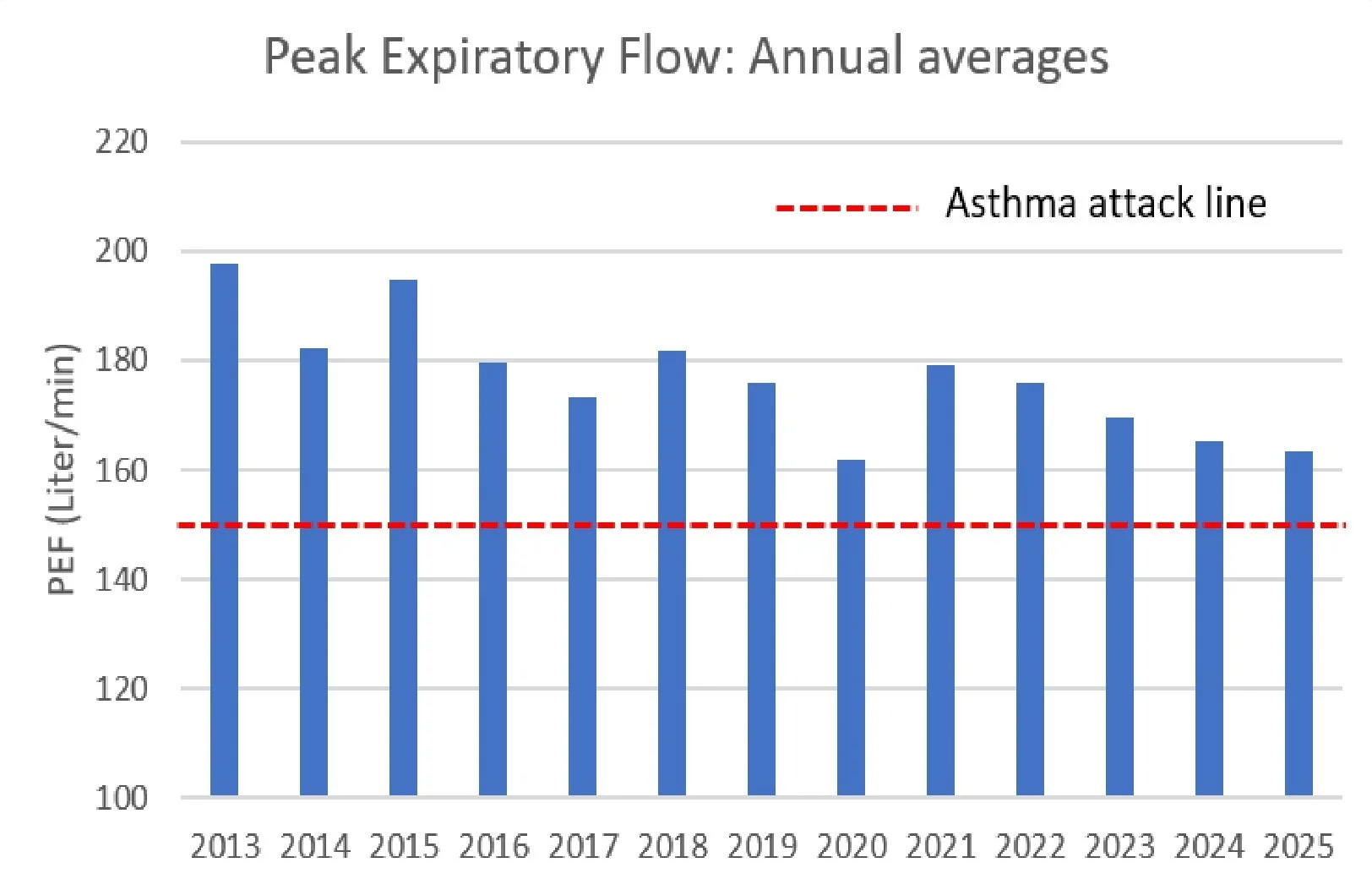
Beginning in 2013, her son Sudhir became much more closely involved in managing her health care. He equipped her home with a blood-pressure monitor, peak-flow meter, pulse oximeter, thermometer, and other basic medical equipment so that changes in her condition could be recognized before they developed into a serious asthma attack. Tracking trends in oxygen saturation, peak expiratory flow, temperature, and other measurements became part of the family's effort to understand when her respiratory health was beginning to deteriorate. Sudhir would usually visit India during the winter and, on many occasions, bring Prem back with him to Ann Arbor, Michigan, where she would stay for several months at a time. Those extended stays brought an unexpected benefit: her respiratory health generally improved considerably in Michigan. Away from the intense pollution of Ghaziabad and Delhi-NCR, she experienced far fewer asthma exacerbations—sometimes only one or two during an entire six-month stay.
During these visits, Prem also received pulmonary care in the United States. At Henry Ford Health, she was treated by Dr. Hector Cajigas, who believed that the scarred area in her right lung was likely the legacy of a serious pneumonia or other infection earlier in her life. He worked to reduce her dependence on oral corticosteroids as much as possible. Although the dosage could be minimized, completely discontinuing them proved difficult because her asthma symptoms would return. Prem later received treatment at the University of Michigan under Dr. Michael Coffey. Extensive cultures of her sputum provided another important piece of the puzzle. Testing identified nontuberculous mycobacteria (NTM), including Mycobacterium avium complex (MAC), associated with the vulnerable area of her lung. A prolonged multidrug antibiotic regimen—potentially extending for well over a year—was considered, but because of the intensity and potential side effects of such treatment, her physicians and family decided that treating symptomatic infection episodes as they occurred was the more appropriate course for her circumstances.
Even with specialized care, eliminating oral steroids altogether remained difficult. By this stage of her life, years of corticosteroid exposure had contributed to significant osteoporosis and other health complications. At the same time, spinal stenosis increasingly affected her mobility, making walking more difficult and eventually requiring the support of a rollator. These physical limitations were frustrating, but they never entirely took away her independence or her determination to continue living life on her own terms.
Prem happened to be in the United States when the COVID-19 pandemic began in 2020. What was originally intended to be another extended visit became a stay of more than a year as international travel was disrupted and her family tried to protect her from a virus that posed an especially serious risk to someone with chronic lung disease. During that period, Sudhir enrolled her as a volunteer in the Phase 3 clinical trial of the Pfizer mRNA COVID-19 vaccine. She later learned, after the study was unblinded, that she had received the actual vaccine rather than placebo. For much of the pandemic she remained carefully protected at home with her family.
After returning to India in 2021, maintaining the same degree of isolation was far more difficult. Over the following several years, Prem contracted COVID-19 on multiple occasions. Given her chronic asthma and underlying lung abnormalities, every respiratory infection was a cause for concern, yet she repeatedly recovered and returned to her familiar routines. The viral respiratory illness that led to her hospitalization in August 2025 may also have been COVID-19, although no confirmatory testing established the exact virus. Despite the vulnerability of her lungs, she recovered from the initial respiratory infection. The events that followed during that hospitalization—and ultimately led to her death—belong to a different and final chapter of her story.
Prem's asthma journey lasted for more than a quarter of a century. It involved countless inhalers, medicines, doctor visits, respiratory infections, sleepless nights, and periods when something as basic as taking a comfortable breath could no longer be taken for granted. Yet asthma never became the defining story of her life. She continued teaching children, traveling between India and the United States, painting nearly two hundred canvases, spending time with her family, and maintaining her independence for as long as she could.
Her experience also left her family with a lasting awareness of the importance of the air we breathe. There is little doubt that living for decades in an environment with severe air pollution made managing a chronic respiratory illness more difficult than it needed to be. Economic progress and urban development should not require people to sacrifice their health simply by breathing the air around them. The challenge of air pollution in Delhi-NCR has persisted across decades and across governments, without a lasting solution commensurate with the scale of the problem. Prem's experience is one family's story within a much larger public-health crisis. There is no doubt that her quality of life would have been better if quality of Delhi air would have been better. If we hope to leave a healthier world to our children and grandchildren, clean air cannot be treated as a luxury or an afterthought.